|
Barcelona enjoys a Mediterranean climate, with mild winters and warm summers. It is a coastal city and has over four kilometers of urban beaches and large areas of nearby forest. Although it is a large city, it is easy to get around on public transport and on foot. You can reach any point in the city by metro, bus and taxi.
Barcelona is the capital of Catalonia. Its inhabitants are open and welcoming. The people of Barcelona speak Catalan, their own language, and Spanish. Many of them also speak and understand a little of English and French.
An open Mediterranean city since its foundation, over two thousand years ago, Barcelona has developed its vocation as a great metropolis. Its coastal location and proximity to France have contributed to their situation. Furthermore, Barcelona has experienced continuous cultural enriching with the passage of the Romans, Arabs, Christians…
Barcelona has managed to make use of the great historical events it has led to project itself on the future: the Universal Exhibition of 1888, the International Exhibition of 1929, the Olympic Games of 1992, all transformations that have created new districts and structures, new communications networks and better services in a city that maintains unaltered its traditional hospitality. This dynamism, so typical of the character of Barcelona, has impregnated the urban and economic development of the city to such an extent that Barcelona is now preparing its latest challenge: the Universal Forum of Cultures for the year 2004, a new occasion that will give it a further technological, economic and social boost.
Located in the Mediterranean coast of the European Union, Barcelona is the second largest city in Spain and the economic and administrative capital of Catalonia. Throughout history the city has always been an important industrial, commercial and service centre.
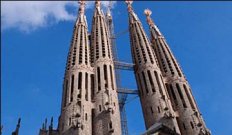
Barcelona is known throughout the world as a cultural city with considerable heritage and a permanent, dynamic offer, a rich architectural and monumental heritage with works that have been declared part of the world heritage by the UNESCO. It is the city of Gaudi and Modernism; the Eixample is the largest open air museum of Modernism in the world, and to celebrate its 150th birthday, in 2002 Barcelona is preparing a year dedicated to the personality and work of Gaudi, with an extensive program of exhibitions, studies, seminars and visits to certain buildings which will be open to the public during the year.
Barcelona offers innumerable possibilities for free time activities. The city’s cultural agenda offers a large variety of shows, popular festivals, theatre, dance, music, opera, flamenco and exhibitions. Over 40 museums : collections, single artist exhibitions such as the Museu Picasso, the Fundació Joan Miró and the Fundació Antoni Tàpies, the largest collection of Roman art in the world, periodical contemporary art exhibitions and a large number of art galleries.
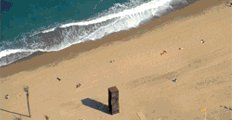
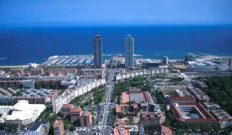
Barcelona faces the sea, and as a Mediterranean city by antonomasia, it presents visitors with a renovated sea front full of activity. The Port Vell and the Olympic Harbour bring together a broad offer of gastronomy and leisure, from the early morning to the daybreak. The 4 km. of beaches provide for all kinds of marine sports, or simply allow the visitor to enjoy the sun and the most complete seaside offer.
Barcelona is the third most important trading port in the Mediterranean and a favourite stopover point for luxury cruise liners. The medieval shipyards bear witness to the splendour of maritime trade and the Catalan naval fleet of the Middle Ages.
Finding your way about in Barcelona is not very difficult, but you should bear in mind some important references: The centre of the city is of course Pl. de Catalunya, to the south of which you can find the old town and most of the museums and other historical places of interest of the city. The famous Rambla meanders from the Plaça de Catalunya down to the Columbus statue, just before the port. To the east of the Rambla you can find the beautiful and romantic Barri Gòtic and to the west, the Barri del Raval.
From the Columbus statue you can follow Passeig Marítim (Seafront walk) to the east, past the Moll de la Fusta, and Port Vell, the colourful Barceloneta area and up to the Port Olímpic (Olympic Harbour). To the west, following Paral.lel you get to Plaça d'Espanya from where Montjuïc, one of the mountains of Barcelona, rises up.
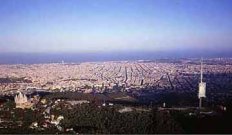
The other mountain, Tibidabo, marks the northern limit of the city. The popular Av. Diagonal is another important landmark, since it runs diagonally across the whole city.
Between Diagonal and Pl. Catalunya is most of the "Eixample" area ("expansion" in English), which arose from the famous "Pla Cerdà" (Cerdà's city plan), L' Eixample, with its square blocks of houses forming a grid pattern, has as its main boulevard the Passeig de Gràcia, where you will find the famous "Pedrera" by Gaudi.
Ciutat Vella –the heart of the city- Until the end of the 19th century, the ciutat Vella district was the city of Barcelona. It is famous for its historic monuments, narrow streets and vaguely bohemian atmosphere.
The Gothic Quarter is the heart of the medieval part of the city which, until the mid-19th century, was contained within the city walls. A walk through its maze of streets brings us to the Cathedral, the origins of which date back to the 13th century. Nearby, the Pl. del Rei is the historic centre of the district, with gothic buildings which were an integral part of the Palau Major, the residence of the Catalan monarchs.
In the Pl. Sant Jaume we find the city hall and the Palau de la Generalitat, seat of the catalan Government.
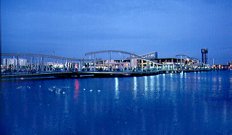
La Ribera is a maze of medieval streets, such as the Carrer Montcada, with its succession of palaces which reveals Barcelona’s commercial prosperity between the 13th and 15th centuries. At the end of the Carrer Montcada is Santa Maria del Mar, Barcelona’s most beautiful gothic church. Another outstanding building in the district is the Palau de la Musica Catalana, a spectacular modernism (catalan Art Nouveau) building.
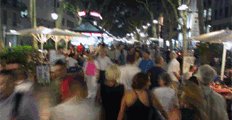
La Rambla is a lively and entertainment spectacle, justly renowned throughout the world. It begins in Pl. Catalunya and continues down to the Mirador of ColóMn;, in the harbour, past long-established shops, cafes, the Boqueria -the city's finest market-, the Gran Teatre del Liceu -the opera house-.
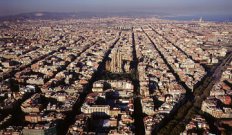
After 1860, and the demolition of the city walls, Barcelona began to expand. Its new district, known as the Eixample is, without doubt, a unique example of European urban planning. Today, the Eixample is Barcelona’s main centre: a shopping and residential area district whose streets feature a succession of prestigious shops, art galleries, restaurants and night-time bars.
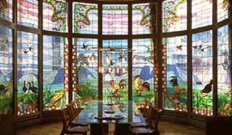
Modernism is an artistic movement dating from the end of the 19th and the beginning of the 20th centuries, which found one of its greatest means of expression in architecture.
|